reabc/Anarchist Litigation for Dummies - Gary William Hallford/Anarchist Litigation for Dummies - Gary William Hallford.pdf
Web PDF • Imposed PDF• Raw TXT (OCR)






![Additional Points and Authorities to be Found on Following Page 17 May Peace and Justice Come Soon PLEASE NOTE: There are innumerable people and/or organizations which are desperate for funds to continue the struggle ON OUR BEHALF. Anthony is not a financially gifted nor are the groups noted in the Points and Authorities. EVERYONE IN THE GULAGS SHOULD SEND SOME “DONATION" DURING THESE ECONOMIC CRISES...(if not us, then who’ll bring them relief?).---PEACE--- POINTS AND AUTHORITIES 1.) Turner v. Safely, 482 U.S. 78 (1987); Farmer v. Brennan, 511 U.S. 825, 832 (1994); et al. 2.) Jones v. Bock, 127 sS.Ct. 910 (2007), Followed in: Freeman v. Watkinss, 479 F.3d 1247 (10E] Cir. 2007); et al. 3.) United States Costitution, Amendment #1; ¥Congress shall make no law respecting an establishment of religion, or prohib- iting the free exercise thereof; or abridging the freedom of speech, or of the press; or of the people peaceably to assemble, and to petition the govern- ment for a redress of grievances. 4.) The Magna Carta, Chapter 36: Henceforth nothing shall be given or taken for a writ of inquest in a matter of life or limb; but it shall be conceded gratis, and shall not be denied. 5.) Rasul v. Bush, $24 §.8t. 534(2004); Al 0dah v. U.S., 124 S.Ct. 2686 (2004)](Anarchist Litigation for Dummies - Gary William Hallford 17.png)
![6.) 8.) 9.) DeMallor; Cullen, 855 F.2d 442, |¥ 296 40 (TEh"Cir. 7968); Johauon Avery, 393 U.S. 483, 485 (1985); et al. United States Constitution, Amendment 4: "The right of the people to be secure in their persons, houses, papers and effects, against unreasonable searches and seizures, shall not be violated, and no warrants shall issue, but upon probable cause, supported by oath or affirmation, and particularly describing the place to be searched, and the person [s] or things to be seized. Patriot Act I, (October 2001); United States Constitution, Article IV, Section 2, Paragraph 3: No person held to serv- ice or labor in one state, under the laws thereof, escaping into another, shall, in consequence of any law or regulation therein, be discharged from such service or labor, but shall be delivered up on claim of the party to whom such service or labor may be due; Fugitive Slave Act (1850). U.S. v. Ready, 82 F.3d 551, 559 (24 Cir. 1996); william W. Wilkins, Jr., "Plea Negotiations, Acceptance of Responsib- ility, Role of the Offender, and Depar- tures: Policy Decisions in the Promul- gation of the Federal Sentencing Guide- lines, 23 Wake Forest L. Rev. 181, 184 23 Wake Forest L. Rev. 181, 184 (1988) Continued: Turner v. Safley (supra); Crawford-El v. Britton, 523 U.S. 574, 584 (1998); Cody V. Weber, 256 F.3d 764, 768 (8th Cir. 2001); Ex Parte Hull, 312 U.S. 546, 548- 549 (1947); Bear v. Kautzky, 305 F.3d 802 (Bth Cir. 2002); et al.](Anarchist Litigation for Dummies - Gary William Hallford 18.png)
ANARCHIST
LITIGATION
For
DUMMIES
By, Gary William Hallford
ANARCHIST LITIGATION FOR DUMMIES
By Gary William Hallford 2
Those of us buried in the obscenity
of the Criminal Justice System, usually
do not have much educational resources
from which to attack the absurdity we've
been thrown into. That's a given. There
is no reasonable method to explain why
schools are being closed, while prisons
continue to be built, other than being
fraudulently displayed to the paniced
taxpayer who wishes to protect whatever
he or she has amassed as "wealth". Over
the last couple years, the definitions
of "wealth” have become more abstracted,
leaving almost no previous rationales
worthy of valid expression.
For anyone who has refused to employ
the concepts of "Evolution", they have
lost sight of the simplicity of change,
and what necessity sometimes requires of
each entity or process. This evolution
is also required in Judiciary processes,
and every other human interaction. Just
to be expeditious, civil rights actions
are an effective method of implementing
change, but the Courts will reluctantly
look at proposed changes. It would appear
they are more inclined toward accepting
"traditional hypocrisy" than “embracing
social discourse", partly from ignorance,
but most likely from their own personal
prejudice(s) coming to the foreground.
If you place 1,000 "Generic People”
in an Assembly Hall, odds are you will
find more intricate differentiations
than there are people. Whether the noted
differences are of age, race, ethnicity,
gender, sexuality, political beliefs,
religion, favorite pass-time, beer-brand,
or a Trillion other minute details the
fact remains that people rapidly become
either adamantly opinionated, or almost
oblivious to the guestion presented...,
and raising the awareness of those who
find no direct causation for interest,
requires either an incredible patience,
combined with artistic creativity beyond
most people's imagination. The following
is a “Crash Course" for doing/bringing
about positive social development, all
on the Judiciary's dime....
Part 1, Initiating a Complaint.
Just for the sake of this exercise,
let's consider that access to religious
services are restricted, or you're denied
adequate access to the Law Library in
your institution. These are common issues
and there have been a plethora of legal
decisions regarding various aspects of
these issues. However, until someone
knows you've been wronged, relief can't
be received. So, you file a grievance
to the supervisory personnel directly
overseeing the situation (1), because
this is required by Prison Litigation
Reform Act, which requires you "exhaust
administrative remedies" prior to filing
suit in Federal Court. Recently, there
has been a Supreme Court decision which
appears to loosen the requirement (2),
but for safety sake, it is preferable
to thoroughly exhaust whatever grievance
system is available in your prison.
While there is a dichotomy between
Anarchist principles and the addressing
of grievances to a governmental entity,
you can't legitimately go from having
a complaint, to receiving some answer,
without reaching forward with a legal
document. In the California gulag there
is a rather useful form called a 602,
and a new 602-HC (Health Care), and
also an 1824 (Americans w/ Disabilities
Act Accommodation Form). Other juris-
dictions will have different terminology
but for this example, California forms
will suffice.
0ddly enough, the only people with
lower educational backgrounds are those
who find themselves "working" for these
gulags. Therefore, use the K.I.S.S.
system: Keep It Simple Stupid. Going
too far into detail will obscure the merit
of your complaint. If you are forced into
using technological idioms the screener
is not going to readily know, provide
a brief description of the matter. Should
the problem involve an obscure medical
terminology, expect the screener doesn't
have an M.D. behind their name; and if
the problem involves a legal situation
outside the normal run-of-the-mill issues,
do yourself a favor and provide explicit
definitions and terminology as required
in the legal field. This is extremely
useful in Immigration matters, Political
Asylum Requests, etc....
As is unfortunately normal, screeners
will blow smoke up your ass and create
issues where they previously didn't exist.
Among their tactics are an array of odd
demands for information already in their
possession (in your confidential & medical
files); a method of changing the gquestion
into something that doesn't resemble
what you sought rectified; and/or, deflect
the answer into something which addresses
nothing the appellant/complainant brought
into question.
This is simply an attempt to intimidate
and confuse, leaving you confused over
the situation. In some cases, they will
not even respond to the inquiry. At the
abattoir known as California State Prison-
Solano, I had difficulties with an Appeals
Coordinator who refused to supply answers
to assorted complaints. Finally, in some
desperation, I sent him a 602 en francais!
He responded with an acknowledgement that
I spoke and wrote adequate English, that
using French was a waste of his valuable
time. My reply? Since he had given the
first "Informal Response”, the next one
Iequired a log number, thus forcing the
appeal up the Chain of Command...he wasn't
happy with being "punked", but the same
Appeal is in a 42 U.S.C.§ 1983, currently
being reviewed by the Ninth Circuit.
Another tactic they use is to overly
delay their response. For example, there
can be a simple statement of absolute
truth ("the sun rises in the East") they
are not willing to admit. In the 602
system, the complainant is required to
respond to whatever reply is received
within 15 day. Technically, the CDCR's
supposed to play by the same rules, but
almost never do. If you hit then with
an extremely complicated question, they
often will extend the "due dates" for
an extensive period; only for delivery
17, 18, 21 days past the date of their
having signed the 602. In this instance,
if the staff member is willing to do so,
have them sign the form with a "Delivery
Date". This will usually only be useful
for one or two times, because the Staff
will catch heat for subverting the other
Staff's subversion (yeah, it becomes a
childish soap opera...).
The key point is to persevere through
this maze of idiocy and either obtain
the relief you sought, or an adequate
response to your complaint explaining
their "justification" for denying this
relief. In California, between beginning
and end, usually Eight Months Elapse,
and the majority of State Tort Claims
have a Six Month "Statute of Limitations"
between the harm done, and the potential
relief being afforded. If State Agencies
delay the process long enough, the Courts
will refuse to hear the case....
Needless to say, this is a complicated
and confusing system, abused by those
whom are "entrusted by the public" with
protecting the public's rights. PRISONERS
ARE PART OF THE PUBLIC! Though we have b
limited rights, the Right to Petition
the Government for Redress of Grievances
(3) is one of our most valuable. Without
it, we are essentially neutralized from
being effective members of any political
body, and become hopeless, helplessly
distraught, meaningless entities. Failure
to recognize this truth is damning....
Part 2, How to Apply Completed Complaint:
Where to utilize the response elicited
depends entirely upon the specific type
of complaint is involved. If the issue
is over property damage, then a State
Tort Claim is probably the area to bring
Court scrutiny. If the issue involves
a well defined U.S. Constitutional Right,
42 U.S.C.§ 1983 is the appropriate venue
to file suit in. In some cases, you're
able to file both State & Federal Claims
simultaneously. This will depend mostly
on the Court in your jurisdiction, and
even when you proceed with one venue,
there is a strong likelilicod an Attorney
General will change venue (from State
to Federal) to deflect your attention
from the abuse of power. I personally,
filed a State Tort against Corruptional
Officers (IN THEIR PERSONAL CAPACITIES),
only to have a Deputy Attorney General
move the case to Federal Court, claiming
it was a "Federal Question". For those
readers who get Prison Legal News, in
February 2009, you'll see a story about
the USDC Eastern District of California,
“farming out” cases to "foreign courts”",
2:07-cv-1068-PMP, is now being stalled
in the USDC District of NEVADA, because
USDC District of NEVADA
the California Court is buried in cases
{2500 from unhappy prisoners). Through
some hocus-pocus, and use of a Ouija
Board, the Ninth Circuit has chosen 7
to relieve the Eastern District of cal-
ifornia of their excess baggage (nothing
is being done, except using smoke and
mirrors...), delaying basic human rights
for unbelievably long periods of time....
All this being said, you now have
a completed 602 before you, and no relief
has been obtained. For the sake of this
essay, let's consider a hypothetical
situation where you were denied access
to religious observations, and you are
not segregated by specific disciplinary
circumstances. Your only problem invelyes
some kind of "Home-Roy" network which
prevents you (as an outsider) from being
allowed/accepted into the service. Whilg
you noted some intricate case law during
the grievance, usually you do not want
to reach in to a Federal Court and tell
them what the law says (they are far
more qualified than you are to determine
the definition...). So, you write them
a short story:
Who you are;
Who the Defendants are.
What harm has been done;
Who specifically is responsible;
What relief you seek;
If it's an obscure issue, provide case
law of pertinence;
Request In Forma Pauperis status to
delay paying any fees;
(OPTIONAL)-Request representation to
protect your interests with professional
legal assistance;
(OPTIONAL)-Provide specific State-Sponsored
exhibits of pertinence.
0dds are they won't allow an Attorney,
so do your home-work. Multiple examples
of religious persecution cases have been
Qecided, some benefit your case, others
go directly opposite what are arguable as
being beneficial/derogatory to the case.
In one specific case, I submitted 47
State Auditors Reports as Exhibits. They
were pertinent and show the State to be
acting fraudulently in countless areas.
In another one, I've submitted documents
proving a conflict of interest where they
refuse to provide public documents for
exhibits (Government Codes!?!?!). These
are documents which should be made readily
available via either the Federal Freedom of
Information Act, or State Public Records
Acts. Essentially, you have to fight for
the most basic accommodations which already
are guaranteed by law (?). All you can do
is keep struggling forward.... ¥
part 3, Filing Fees and Other Costs:
The Courts really don't want to hear
from "non-professionals", and have created
a cost system that scares away most folks.
Habeas Corpus is an age-old Right of which
the Courts have been reluctant to overtax,
leaving the cost at only $5.00 per filing.
With nearly 800 YEARS OF GUARANTEEING THIS
RIGHT make it rather difficult to destroy
through political subversion (4).
CIVIL RIGHTS ACTIONS are far different:
State Torts vary by locality, but you're
still allowed to bring "legitimate" suits
without prepayment (in forma pauperis).
Federal Actions under 42 U.S.C.§ 1983 must
eventually be repaid. There are only three
levels of Federal Court, and they receive
different prices:
District Court = $350.00 9
Circuit Court = $455.00
Supreme Court = $300.00
The vast majority of cases are settled
(or dismissed) in the District Court and
are also more politically charged" with
assorted biases. Circuit Courts have turned
rather "BX»Polaz", and are following some
rather bizarre internal dogmatism their
"area” doesn't necessarily reflect. There
is virtually no chance of having a case
heard by the U.S. Supreme Court, unless
there is a significant "public interest"
in the decision (defining an established
law; argue the Contitutionality of recent
legislation; or, challenge legislative
and/or executive authority; or, of recent
interest, determine the legitimacy of
"War Powers" of an illegitimate President)
(5.). At any rate, the key point to watch
is that you not worry about the costs.
To borrow an old term: "A closed mouth
won't get fed".
Being indigent and representing yourself
the Courts are supposed to allow the basic
errors and violations of Rules of Court to
be “"overlooked" (6), but this depends more
on the specific Court. Some will be very
kind, while others will crucify you. BEFORE
FILING, ASK OTHER LITIGANTS WHAT EXPERIENCE
THEY'VE HAD IN THIS COURT!!! Also, check
out the Magistrate assigned. Does he have
a history of acting unfavorably against
prisoners? If he has acted "justly", were
the plaintiffs proceeding pro per, or
did they have hired counsel? If the Judge
has a history of acting one way towards
attorney-represented litigants, and another
way against pro per complainants, there's
a reasonable probability of prejudicial
thought being brought forth. ASKING JUDGES
TO RECUSE THEMSELVES OPENS THE DOOR FOR
FURTHER ABUSE OF DISCRETION. They do not
like anyone "pissing in their fishbowl".
TO RECUSE ONE DOES NOT PREVENT THE OTHERS
FROM "OVER-RULING" YOUR FUTURE OBJECTIONS.
Be very careful in your potential challenge
of any Judge, because it will probably
come back to haunt you
Part 4, RESEARCH, RESEARCH, RESEARCH:
Pick any television program...doesn't
nmatter what genre...and consider writing
the script. If you have never been outside
Manhattan, are you qualified writing the
next Western? If you're sitting in a County
Jail in Central North Dakota, do you have
the experience to write about the "Street-
Life" of Chicago? If you're the Governor
of Alaska, do you have sufficient knowledge
and expertise to become Vice-Dictator?
If you want to complain about something,
the only way you'll catch my attention
will be to have some legitimate knowledge
of both the RIGHTS INFRINGED, and LEGAL
AUTHORITY EXPRESSING THIS RIGHT. To simply
pick Constitutional Amendment, does not
necessarily establish the SPECIFICS of
this Right. For an arbitrary example look
at the 4th Amendment. There are places
where it is applicable, but there have
also been "Legislative erosion" from the
“apparent meaning"(8).
within the gulag archipelago most folks
reading this inhabit, there is virtually
no expectation of privacy(9), and there
is almost no case law to benefit your 4th
Amendment rights. However, there are a few
decisions which speak otherwise(10), and
were not received by placing your hands
on your head and pray for relief. Slavery
is not abolished by complacency, but only
by concerted counter-attacks of courageous
audacity...and fighting the urge to panic
and neglect the drudgery of learning just
what you're fighting for and why. Without
some form of "direction", we continue to
repeat others mistakes, and negate our
possibility for relief. However, there's
always an opportunity to counter whatever
inappropriate decisions or actions we're
forced into facing...but it takes massive
amounts of researc
Access to the Prison Law Library tends
to be below the minimum Federal Standard,
and this varies by location and Security
Level of the Institution. The Law Schools
around the nation routinely have access
to Case Law, but the cost varies. Recent
communiques from the only "Free Access"
University in California, show an ongoing
economic crisis has ended “free access",
essentially violating State and Federal
Constitutional rights(11), while allowing
“Free People" ready access(12). As these
developments unduly punish incarcerated
people, there is a DIRE NEED to support
groups which work to bemefit prisoners,
either directly(13), or through useful
texts and journals(14). Among the most
critical texts to obtain is fittingly
called the "Cite Book", which can bring
extremely useful decisions directly into
your hands.
Another organization which should be
considered vital is the Friends Committee
on Legislation (assorted addresses aren't
readily available for other locations),
but are usually available via “Prison
Activist Resource Center", Oakland(15).
They provide a listing of both State
and Federal legislation which has effect
upon our existences. CURE (Citizens
United for Rehabilitation of Errents), has
an annual listing of Supreme Court cases
recently decided(16). The Supreme Court
only allows you to obtain copies of five
decisions each year, but they are useful
tools and resources for study.
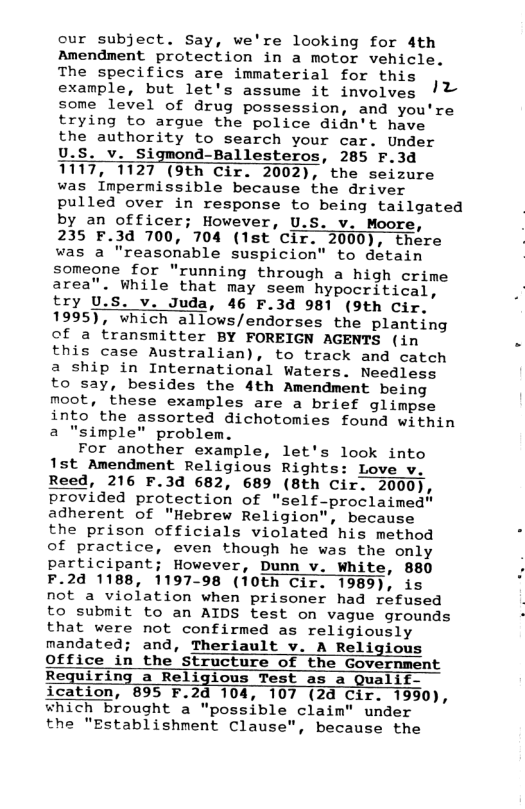
Just for an arbitrary exasplc, let's
take a look at one case and see how it
can create infinite complexities regarding
cur subject. Say, we're looking for 4th
Amendment protection in a motor vehicle.
The specifics are immaterial for this
example, but let's assume it involves !
some level of drug possession, and you're
trying to argue the police didn't have
the authority to search your car. Under
U.S. v. Sigmond-Ballesteros, 285 F.3d
1117, 1127 (9th Cir. 2002), the seizure
was Inpermissible because the driver
pulled over in response to being tailgated
by an officer; However, U.S. v. Moore, .
235 F.3d 700, 704 (1st Cir. 2000), there ,
was a "reasonable suspicion” to detain
someone for "running through a high crime
area”. while that may seem hypooritical, .
try U.S. v. Juda, 46 F.3d 981 (9th Cir.
1995), which allows/endorses the planting
of a transmitter BY FOREIGN AGENTS (in -
this case Australian), to track and catch
a ship in International Waters. Needless
to say, besides the 4th Amendment being
moot, these examples are a brief glimpse
into the assorted dichotomies found within
a "simple” problem.
For another example, let's look into
1st Amendment Religious Rights: Love v.
Reed, 216 F.3d 682, 689 (Bth Cir. 2000
provided protection of "self-proclaimed”
adherent of "Hebrew Religion”, because
the prison officials violated his method
of practice, even though he was the only
participant; However, Dunn v. white, 880
F.2d 1188, 1197-98 (10th Cir. 1989), is
not a violation when prisoner had refused
to submit to an AIDS test on vague grounds
that were not confirmed as religiously
mandated; and, Theriault v. A Religious
Office in the Structure of the Government
Requiring a Religious Test as a Qualif-
ication, 895 F.2d 104, 107 (24 Cir. 1990),
which brought a "possible claim" under
the "Establishment Clause”, because the
Chaplain interfered excessively with
management of the prison.; and Hallford v
CDCR, et al., 07-15335 (9th Cir.)(active),
Tegarding C Solano denying Buddhist's
“Religious Diet", and grooming standards
challenge (I've won it, I'm just waiting
for the final decision being remanded to
the District Court.... )3
Another issue to consider is the way
an oddly impertinent case can be utilized
in a aifferent context. Perhaps the best
example of this is Roe v. Wade, 410 U.S.
113 (1973), is generally looked upon as
the "Abortion Decision", but if you really
ook at it, there is a deep explanation
of the 9th Amendment, which precludes the
government from "unlawfully" interfering
with a persons private affairs. Looking
“outside the box" can be rewarded greatly.
Speaking of "outside the box", there's
over 5000 years of philosophical thought
which can be referenced (though not very
easily) and all have pertinence to modern
legal theory. Besides the rather obvious
Torah/Bible/Qu'ran references (that have
helped shape legal and moral thought),
there are countless scholarly texts which
have significant information to contribute
to your argument. Among these are:
"pwo Treaties of Government", John Locke;
"Ethics" and "Politics", by Aristotle;
"pe L'Esprit des Lois XIV", Montesquieu;
“Du Contrat Social®™ Jean-Jacques Rousseau;
“Either/Or", by Soren Kierkegaard;
"Genealogy oOf Morals" Fricarich Nietzsche;
"gtilitarianisn”, John Stuart Mill;
“The Conquest of Death", Bertrand Russel.
“The Second Sex", by Simone De Beauvoir;
“The Metaphysics of Oppression” J. Valdez;
“Gravity and Grace", by Simone Weil;
(just a few that are referenced in another
“personal” case: Gary William Hallford v.
Each Individual Member of the California
Correctional Peace Otticers Association
And Other Employees of the California
Department of Corrections and Rehabilit-
ation, In Their Personal Capacities, 19
Et Al, 08-16322 (9th Cir.)(active).
Suffice it to say, there are countless
resources to utilize and reference, but
it helps if you actually know what you're
talking about and can craft a cognizant
argument which not only expresses where
you have been wronged, but provide some
rationale at how to rectify the problem.
You don't have to be brilliant, you simply '
have to be dedicated to curing the problem
and bringing the fight in an appropriate
manner which is respected by the Courts
and the People who might be have effects
upon them as well (you don't live in some
kind of vacuum..
Part 5, Retaliation and Retribution:
Personally, I prefer to live a peaceful
and "unassuming" lifestyle...very low key.
However, I also prefer not to have rights
violated by some retarded, State-employee
who can't particularly understand what's
actually going on. The Bullshit can only
effect you if you allow it to; preparation
and contingency plans are an essential
element of surviving the retaliation WHICH
WILL COME. When you know the Defendants
are going to retaliate, a wise litigator
will provide information to outside folks,
and if the threat appears dire enough, it
is essential to protect information (phone
nunbers, addresses, case numbers, etc...),
by either sending "Emergency Information
to TRUSTED outside contacts (friends,
family, etc...), and/or TRUSTED inside
contacts (friends), who can relay the
information back to you either through
the mail, or by hand, depending on the
particular circumstances.
During an episode of retaliation that
resulted in a journey to a SHU, I mailed
my “Emergency Address List" to a friend,
who made copies and returned one to me |
once I landed in the SHU. While my stay
was short, the necessity of having access
to this information can not be over-stated
when you have multiple cases active and
have time barriers to comply with (Courts
do not usually grant extensions vhile
serving a Disciplinary Sanction regardless
of the validity...).
One thing that does bring cheer has to
be the ability of receiving some responses
from Legislators, and other Human Rights
Advocacy Groups. The Threepenny Review
published a letter to the Editor detaili
being denied my reading glasses (THANK
YOU Wendy Lesser!!!), and though it didn't
directly change.my circumstances, others
read about this wanton deprivation and
other matters of torture. The ACLU, Human
Rights Watch, etc..., responded to letters
and a few groups wrote letters of protest
to the California Department of Correction
and Rehabilitation, and assorted gulags
within their "sphere of influence™....
A closed mouth not only doesn't get
fed, but it endures torture too quietly.
IF YOU ARE NOT BEING TREATED JUSTLY OVER
ANY SITUATION, SPEAK OUT LOUDLY AND WITH
GREAT PASSION!!! Failure to resist equates
to surrender....
When you know you will be retaliated
against, HAVE YOUR SHIT TOGETHER BEFORE
IT ALL FLIES APART! You won't regret it.
19
Part 6, Conclusion:
One basic moral dynamic shared across
the various ethnic, religious & political
ideologies, is the wish to not be harmed,
nor harm others. Another is to refrain
from taking things that are not “"freely
given". Within the countless gulags, there
ine,‘inumerable subdivisions. To reach ||
into the abysmal wastelands of rhetoric
and depraved selfishness, and reach for
"something better", seems unthinkable to
people facing personal and economic crises
©Of every version imaginable. The fight
for basic civil rights can only be left
once the goals are reached. "Pie in the
Sky" crap won't fly when everyone's deep
in trouble and the "Savior from Chicago"
is in all reality, the best we can muster.
I'm personally fighting to eliminate
restrictions that don't apply to me. Why?
BECAUSE IT'S THE RIGHT THING TO DO....
All it's done for me was have my sanity
questioned, and the expenditure of almost
everything I own...but, I can go to bed
each night with one promising thought in
ny mind: At Least I'm Trying...". How
many readers can honestly say the same?
Today, my cell mate received EXTREMELY
rapid response from a 602 I sent in last
night regarding his health. My benefit?
Though I'11 probably lose him soon, he'll
live longer...all from a few well chosen
words on a Government Form. Why? BECAUSE
IT WAS THE RIGHT THING TO DO....
April 3, 2009 In Struggle 'til the End,
Gary william Hallford
Author can be contacted by non-prisoners
at the following address:
Gary Hallford, T-58516
Folsom State Prison, 2-A1-21L
.0. Box 715071
2presa, CA 95671-5071
Additional Points and Authorities to be
Found on Following Page 17
May Peace and Justice Come Soon
PLEASE NOTE: There are innumerable people
and/or organizations which are desperate
for funds to continue the struggle ON OUR
BEHALF. Anthony is not a financially gifted
nor are the groups noted in the Points
and Authorities. EVERYONE IN THE GULAGS
SHOULD SEND SOME “DONATION" DURING THESE
ECONOMIC CRISES...(if not us, then who'll
bring them relief?).---PEACE---
POINTS AND AUTHORITIES
1.) Turner v. Safely, 482 U.S. 78 (1987);
Farmer v. Brennan, 511 U.S. 825, 832
(1994); et al.
2.) Jones v. Bock, 127 sS.Ct. 910 (2007),
Followed in: Freeman v. Watkinss, 479
F.3d 1247 (10E] Cir. 2007); et al.
3.) United States Costitution, Amendment #1;
¥Congress shall make no law respecting
an establishment of religion, or prohib-
iting the free exercise thereof; or
abridging the freedom of speech, or of
the press; or of the people peaceably
to assemble, and to petition the govern-
ment for a redress of grievances.
4.) The Magna Carta, Chapter 36: Henceforth
nothing shall be given or taken for a
writ of inquest in a matter of life or
limb; but it shall be conceded gratis,
and shall not be denied.
5.) Rasul v. Bush, $24 §.8t. 534(2004);
Al 0dah v. U.S., 124 S.Ct. 2686 (2004)
6.)
8.)
9.)
DeMallor; Cullen, 855 F.2d 442, |¥
296 40 (TEh"Cir. 7968); Johauon
Avery, 393 U.S. 483, 485 (1985); et al.
United States Constitution, Amendment 4:
"The right of the people to be secure
in their persons, houses, papers and
effects, against unreasonable searches
and seizures, shall not be violated,
and no warrants shall issue, but upon
probable cause, supported by oath or
affirmation, and particularly describing
the place to be searched, and the person
[s] or things to be seized.
Patriot Act I, (October 2001); United
States Constitution, Article IV, Section
2, Paragraph 3: No person held to serv-
ice or labor in one state, under the
laws thereof, escaping into another,
shall, in consequence of any law or
regulation therein, be discharged from
such service or labor, but shall be
delivered up on claim of the party
to whom such service or labor may be
due; Fugitive Slave Act (1850).
U.S. v. Ready, 82 F.3d 551, 559 (24 Cir.
1996); william W. Wilkins, Jr., "Plea
Negotiations, Acceptance of Responsib-
ility, Role of the Offender, and Depar-
tures: Policy Decisions in the Promul-
gation of the Federal Sentencing Guide-
lines, 23 Wake Forest L. Rev. 181, 184
23 Wake Forest L. Rev. 181, 184
(1988)
Continued:
Turner v. Safley (supra); Crawford-El v.
Britton, 523 U.S. 574, 584 (1998); Cody
V. Weber, 256 F.3d 764, 768 (8th Cir.
2001); Ex Parte Hull, 312 U.S. 546, 548-
549 (1947); Bear v. Kautzky, 305 F.3d
802 (Bth Cir. 2002); et al.
10.) Prison Legal News v. Cook,283 F.3d 1145
(9th Cir. 2001); Prison Legal News v.
_Schwarzenegger, (N.D. Cal. 2007); Allah
v. Seiverling, 229 F.3d 220, 225 (3rd
Cir. 2000); Lindguist v. Idaho State Bd
of Corr., 776 F.2d 851 (9th Cir. 1985);
Aby al v. Price, 154 F.3d 128 (3rd
Cir. 1998); et al. 19
11.) United States Constitution, Amendment
14, Section 1: "All persons born or
naturalized in the United States and
subject to the jurisdiction thereof,
are citizens of the United States and
of the state wherein they reside. No
state shall make or enforce any law
which shall abridge the privileges or
immunities of citizens of the United
States; nor shall any state deprive any
person of life, liberty, or property,
without due process of law; nor deny to
any person within its jurisdiction the
equal protection of the laws".
12.) Coalition of Prisoners Rights
to
P.O. Box 1911
santa Fe, NM 87504
16.) Prison Legal News
2400 NW 80th Street, #148
Seattle, WA 98117
Georgetown Law Journal
600 New Jersey Avenue
wWashington, DC 20001
Prison Activist Resource Center
P.0. Box 70447
Oakland, CA 94612
International Cure
P.0. Box 2310
washington, DC 20013
Folsom State Prison
P.0. Box 715071 L
Represa. CA 95671
o s 77
Gary Hallford Zine Distro
—
T-58516 guopey 2 A1 21T Homewood, IL 60430